what is a drawback of using only equity to raise capital?
What is Equity Financing?
Disinterestedness financing refers to the sale of company shares in order to raise capital letter. Investors who purchase the shares are also purchasing ownership rights to the company. Equity financing can refer to the sale of all equity instruments, such every bit common stock , preferred shares, share warrants, etc.

Equity financing is especially of import during a company's startup stage to finance constitute assets and initial operating expenses . Investors brand gains by receiving dividends or when their shares increment in price.
Major Sources of Equity Financing
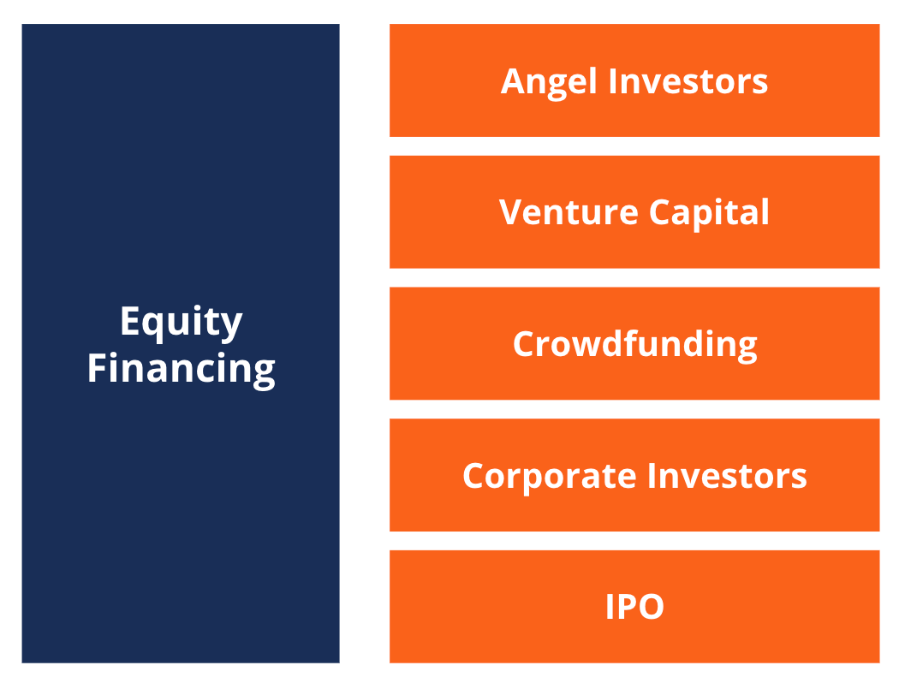
When a company is all the same private, equity financing can be raised from affections investors, crowdfunding platforms , venture capital firms, or corporate investors. Ultimately, shares tin can be sold to the public in the class of an IPO.
one. Affections investors
Angel investors are wealthy individuals who buy stakes in businesses that they believe possess the potential to generate higher returns in the futurity. The individuals usually bring their concern skills, experience, and connections to the table, which helps the visitor in the long term.
two. Crowdfunding platforms
Crowdfunding platforms allow for a number of people in the public to invest in the company in small amounts. Members of the public make up one's mind to invest in the companies because they believe in their ideas and promise to earn their money back with returns in the futurity. The contributions from the public are summed up to attain a target total.
3. Venture capital firms
Venture capital firms are a group of investors who invest in businesses they think will abound at a rapid footstep and volition appear on stock exchanges in the future. They invest a larger sum of money into businesses and receive a larger stake in the company compared to affections investors. The method is also referred to as private equity financing.
4. Corporate investors
Corporate investors are large companies that invest in private companies to provide them with the necessary funding. The investment is usually created to establish a strategic partnership between the two businesses.
v. Initial public offerings (IPOs)
Companies that are more well-established can raise funding with an initial public offering (IPO) . The IPO allows companies to raise funds by offering its shares to the public for trading in the capital markets.
Advantages of Equity Financing
ane. Alternative funding source
The main reward of disinterestedness financing is that it offers companies an alternative funding source to debt. Startups that may not authorize for big banking company loans can acquire funding from angel investors, venture capitalists, or crowdfunding platforms to cover their costs. In this example, disinterestedness financing is viewed as less risky than debt financing considering the visitor does not accept to pay dorsum its shareholders.
Investors typically focus on the long term without expecting an firsthand return on their investment. Information technology allows the company to reinvest the cash flow from its operations to grow the business rather than focusing on debt repayment and involvement.
2. Access to business contacts, management expertise, and other sources of capital
Equity financing also provides certain advantages to company management. Some investors wish to be involved in company operations and are personally motivated to contribute to a company'due south growth.
Their successful backgrounds permit them to provide invaluable assistance in the form of business contacts, management expertise, and access to other sources of capital. Many affections investors or venture capitalists volition assist companies in this manner. Information technology is crucial in the startup period of a company.
Disadvantages of Equity Financing
1. Dilution of buying and operational control
The chief disadvantage to disinterestedness financing is that visitor owners must surrender a portion of their ownership and dilute their control. If the company becomes profitable and successful in the hereafter, a certain percentage of company profits must also be given to shareholders in the grade of dividends.
Many venture capitalists asking an equity pale of 30%-l%, especially for startups that lack a strong financial background. Many company founders and owners are unwilling to dilute such an amount of their corporate ability, which limits their options for disinterestedness financing.
ii. Lack of tax shields
Compared to debt, equity investments offering no revenue enhancement shield. Dividends distributed to shareholders are not a tax-deductible expense, whereas involvement payments are eligible for tax benefits. It adds to the cost of equity financing.
In the long term, equity financing is considered to be a more costly course of financing than debt. Information technology is because investors crave a college rate of return than lenders. Investors incur a high gamble when funding a company, and therefore expect a higher return.
Larn More
CFI offers the Commercial Banking & Credit Analyst (CBCA)™ certification program for those looking to take their careers to the next level. To keep learning and developing your knowledge base, please explore the additional relevant resources beneath:
- Uppercase Raising Process
- Debt Financing
- IPO Process
- Rate of Return
betancourthoel1969.blogspot.com
Source: https://corporatefinanceinstitute.com/resources/knowledge/finance/equity-financing/
0 Response to "what is a drawback of using only equity to raise capital?"
Post a Comment