Everything You Need to Know About Rc Airplaines
RC Airplane Earth flying schoolhouse
- lesson #one : buying your RC airplane
As a newcomer to the radio control flying hobby, choosing and ownership your rc airplane correctly is going to have a big touch on on your initial enjoyment of radio control flying.
Why? Simply considering if yous buy an aeroplane that's non suitable for a beginner, or is of poor quality, you'll have a nasty start feel with information technology and you'll very likely be put off rc flying for life - then please don't let that happen!
What to look for when buying your RC airplane
Design configuration
For your starting time radio control plane you lot need something that is stable and forgiving. This is so important, and many beginners are besides tempted to buy an rc plane that looks absurd or can fly fast, without giving much thought to how easy the thing is to control. Big mistake!
The perfect airplane to learn to fly on is a high wing trainer. By 'high wing' we mean that the wing sits on top of the fuselage, and this configuration means lots of stability in the air - exactly what y'all need when learning to fly radio control.
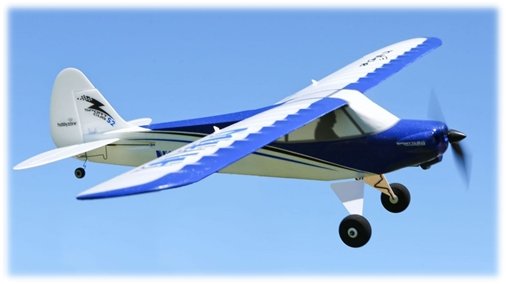
Higher up: HobbyZone's Sport Cub S is the classic
trainer configuration.
Loftier wing airplanes are stable and forgiving because the weight of the fuselage below the wing ever acts to stabilise the aeroplane in flight. A high wing plane will always want to right itself naturally after a plow and this action really helps you out when learning to fly.
The other matter you need to look for when buying your first rc plane is noticeable dihedral. This is the upward 'V' angle of the wings when viewed from the forepart. The more than dihedral the wings have, the more stable the plane is going to exist (up to a point).
Again, this is because of the 'pendulum' consequence of the fuselage hanging below the fly; the lower the centre of gravity is in relation to the wing surfaces, the more than stability there is.
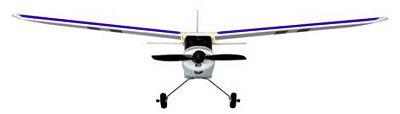
Above: wait for the obvious upwardly dihedral bending of the wings,
when viewed from the front end.
Another reason for dihedral is that airplanes without ailerons (i.e. they rely solely on rudder for turning) need dihedral to aid the turn. As rudder is applied, the aeroplane yaws to that direction and the dihedral then forces the plane in to a banked turn. That's an over-simplified version of events, but it's called Dihedral Effect.
RC airplanes that practice take ailerons volition take noticeably less dihedral than those without, equally a general rule.
Then and so, for your first rc airplane you lot should be looking for a high wing configuration with expert dihedral - the archetype 'trainer' blueprint.
Power blazon
You might take already decided whether you want to wing a plane with an engine (IC: Internal Combustion power, unremarkably glow plug) or 1 with an electric motor (EP: Electrical Power), but if you haven't then hither are some pros and cons to consider...
EP rc airplanes are a lot more beginner friendly; they are cheaper to buy and to wing, they require less accessories, they have less of a nuisance factor considering they are quieter, and they are more than welcome in public places (where rc flying is permitted, of course).
Conversely, a glow plug powered aeroplane (or any IC i) requires more accessories considering of starting and maintaining the engine, y'all'll have ongoing fuel costs, they generate much higher noise levels and are, generally speaking, larger and more expensive than EP beginner planes.
Club membership and access to a proper flying site or individual country is more of a requirement with an IC powered aeroplane, since they are non every bit welcome in public places because of the noise.
And so if you're on the fence and can't make up one's mind which power type to go for, go with electric - y'all'll have an easier, cheaper and cleaner introduction to the hobby of radio control flying. There'south no question almost that.
If you beloved the smell of burned fuel and the noise of an engine, become with IC. More thoughts on IC vs. EP.
How many channels (controllable functions)?
This is an of import question and, once more, choosing badly could determine how much fun you take with your new rc aeroplane.
For the simpler 'Park Flyer' type electrical rc airplanes (the ones we're focusing on in this flight school) 3-channel planes are about mutual for cocky-education.
Single and 2-channel rc airplanes are available but they are more toys than anything else, and non worth spending any money on if you're serious about the hobby. A 2-channel rc plane is easy to fly simply very limited in what information technology tin can practise.
And then, for a true gustation of radio control flying, a three-channel plane is what you really need. A 3-channel plane volition take control to motor, elevator and rudder although an optional configuration is motor, lift and ailerons. A rudder is more commonplace on beginner rc airplanes though - ailerons tend to exist on faster planes capable of more aerobatics, where they need the adequacy to roll smoothly - which aileron control gives.
Of course, there's nothing stopping you diving correct in with a iv-channel trainer such as the E-flite Apprentice 15e, for example. Such an rc plane isn't quite as straightforward to cocky-teach with just ultimately they are more rewarding to fly. Plenty of beginner rc pilots take started their journey with a 4-aqueduct trainer.
A 4-channel plane volition accept control to motor ability, ailerons, rudder and elevator - that actress aqueduct (ailerons) does steepen the learning curve somewhat because of the extra co-ordination needed, that'southward why self-instruction on such a airplane isn't as piece of cake as on a 3-channel one.
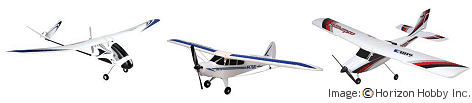
In a higher place: the Firebird Commander 2, Super Cub LP and Amateur 15e
electric RTF rc airplanes - two, 3 & 4 channels respectively and all meant for beginners.
For the purpose of this RC Airplane World Flying School though, we'll stick with a 3-channel plane with motor, elevator and rudder control, something similar HobbyZone'southward Sport Cub Due south.
Kit, ARF or RTF?
The 'completeness' of your first rc airplane is purely down to your ain personal preference.
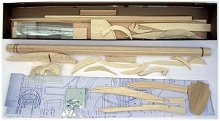 A kit involves building the plane from a box of pieces over a program. Very satisfying, but you lot need a fair noesis of model building skills to practise information technology well and you'll need to purchase the motor, ESC, battery pack and radio gear separately.
Unless you lot actually desire a traditionally constructed balsa/ply trainer as your first airplane, it'due south not advisable. Larn to fly commencement before risking the horrors of crashing a airplane that's taken you much time and effort to build!
If y'all purchase an ARF (Well-nigh Fix to Fly) rc airplane it will be almost 90% finished. You just need to purchase the motor, ESC, bombardment pack and radio gear separately and install it all yourself. Once again, some modelling knowledge is required just in that location won't be much building to worry virtually.
ARFs make an first-class introduction to model airplane construction, if you exercise want to get involved in that side of the hobby likewise as the flying (larn more well-nigh ARFs).
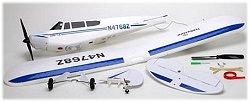 Buying an RTF (Ready To Fly) aeroplane is your all-time option if you but want to get flying in the to the lowest degree amount of fourth dimension. RTF rc airplanes come fully finished with all electronics (motor & radio) installed. In that location'south zip for you to do apart from some very basic assembly piece of work (eg attaching wing to fuselage), charge the battery pack, install the transmitter batteries and wing.
Electric powered (EP) beginner RTF planes take attracted a huge number of newcomers to the hobby over the years; they're affordable, convenient and offering the quickest route to getting airborne. Primarily of foam construction they are tough too, only easily repairable should the worst happen (learn more about RTFs). Talking of which....
Spare parts availability
REALITY CHECK : it'south a fact of the radio control flying hobby that crashing is all part of the action!
When you're learning how to fly rc airplanes the chances are good that you will crash sooner or later - and if y'all're a consummate newbie, and so it'll probably be sooner.
Having an off-the-shelf supply of spare parts is very convenient, and when you're looking around at ownership your first rc airplane exercise have the time to check whether spare parts are bachelor. Certainly brands such as HobbyZone and ParkZone, for example, behave all the parts you could wish for.
By and large speaking, spare parts for foam RTFs are quite inexpensive - much cheaper than parts for a balsa/ply plane.
If you buy an rc airplane that doesn't accept a good back-up of parts behind it then you're in for some potentially dodgy repairs that could seriously impede the safety and functioning of your plane, mail-crash.
Where to buy your RC airplane
If you've got a local hobby store, the best matter you tin can practice is pop forth and have a conversation. My website will give you all the info you lot need to understand what you should be buying, simply talking face to face up with an rc enthusiast is better. And helping back up your LHS is the right thing to do - many many rc shops accept gone out of business in recent times due to low profit margins and tough contest.
Simply beware! There are some unscrupulous shop owners out there who are interested in nothing more than getting hold of your hard-earned cash - they might not have your all-time interests at middle when it comes to yous really learning to fly. Selling a newbie something expensive and completely unsuitable sadly happens from time to time.
If you do buy from a store, be happy that they're selling yous something appropriate and not just the well-nigh expensive aircraft in their store that yous'll boom on its maiden flying, then you lot'll exist back to buy another...
Buying online is your other choice and that's perfectly acceptable. Stay shut to the advice and info in this page and the website in general and y'all won't make it incorrect. But once again, be careful - we all know the internet is a minefield.
And so of course there's good ol' eBay, merely don't be tempted to purchase something cheap and nasty from China or Hong Kong from a brand you've never heard of, simply because the price is too skilful to be truthful (if it is, then it probably is!). If in doubt inquiry the airplane you're thinking of buying - ask around, cheque forums, cheque out videos of it on YouTube - in short, just be aware of exactly what you're buying, and from who.
Well the in a higher place pointers should requite you an thought of what to look for in your get-go plane. If y'all desire more detailed information on the to a higher place, and getting in to rc flying in general, cheque out my popular ebook The Beginner'due south Guide To Flying RC Airplanes.
 Next upwards: Lesson 2 - Get to know your rc aeroplane.
Or skip to the lesson appropriate to your current state of affairs...
- Lesson ii: Know your rc airplane
- Lesson 3: Preparing your aeroplane
- Lesson iv: Weight and residual
- Lesson v: Where to wing your plane
- Lesson 6: Pre-flight checks
- Lesson vii: Take off / hand launch
- Lesson eight: Flying your rc plane
- Lesson 9: Landing your rc airplane
Related pages
Pages that are not part of this 'flight school' section of the website but are closely related to this lesson include:
 Beginner rc airplanes.
Electric rc airplanes.
RC trainers.
betancourthoel1969.blogspot.com
Source: https://www.rc-airplane-world.com/buying-your-rc-airplane.html
0 Response to "Everything You Need to Know About Rc Airplaines"
Post a Comment